Bike ride on Sunday at
Clark County Wetlands Park. The trail crosses and follows the Las Vegas Wash, which drains the Las Vegas valley. Mostly that's not much of a job, except when it's a huge one. It never stops rains here but it pours. This region gets most of its rain as thunderstorms, and the rain runs straight off the parched, mineralised land, causing flash floods. The amount of water-management infrastructure in this desert city is perplexing until you've been in a summer storm here.
This park is downstream of a 'reclamation facility', so the jade coloured water, rich with fish and bird life, is 'reclaimed urban water, not fit for human contact.'
(Euphemism: level 'master')
Okay, so no swimming.

The trail is a fairly new paved path that twines around in gentle swoops and dips through low rises of sediment and conglomerate. There's a lot of creosote growing alongside the higher parts of the trail. (By the water, rushes and occasional stands of trees. We saw a white heron.) They've done a lot of planting - we were bemused to see irrigation systems all over the place.
And because there was all this
creosote and all this water, there was the smell of wet creosote, which is to me the smell of wet desert. It's how this land smells during and after rain, and on damp mornings and evenings, even in those rare places where there doesn't seem to be any creosote nearby. It's hard to describe, but sort of like if dogs designed a pee-scented cologne? Not in a terrible way ... medicinal and peculiar, pungent and distinctive, and weirdly organic and alive.
And because it's a smell, and smells drill a core straight to the cerebral cortex, I will always remember the first time I smelled this. It was in the
Lost City Museum at Overton, and I had no idea what it was, but the whole adobe building was redolent with it. (The small but wonderful Lost City museum houses the rescued remains of the Pueblo Grande de Nevada, 25 miles of Ancestral (Anasazi) Pueblo dwellings and structures, much of which was drowned by Lake Mead in the 30s (I wonder whether, like the ghost town of
St Thomas, the receding waters have left anything to see? Overton Beach is now over 20 miles from the shore of Lake Mead. I have the 2014 and 2015 versions of the
Lake Mead NRA official maps - their shorelines are noticeably different from one another.))
The next time I smelled wet desert, it was nearly a year later, on a day after rain - actually not far from the wetlands, downstream on the path to Lake Las Vegas. We had cycled out to have a look, the day being only 32 degrees or so (low 90s, Fahrenheiters), though the air was hanging heavier and moister than usual. This time I understood approximately what it was, because it was everywhere ... because creosote is everywhere here. Mind you, I didn't yet know what creosote was.
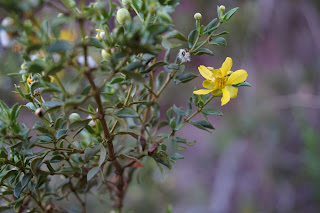
Creosote has little leaves shaped sort of like thyme, and stylish golden yellow flowers, and - to me, most strikingly, amazing little fuzzball seeds. Why wasn't everyone talking about this plant with the fuzzball seeds? It was everywhere.
When I finally understood, I felt like a bit of a muppet (again.) (Also did that just now as I realised it's also the same thing as greasewood. Gah there is so much to learn!)
And weirdly, two of the signature plants of this kind of desert,
sagebrush and creosote, both have species names 'tridentata'. Coincidence? Hmmmm.

 The old lake sediment must be exactly the perfect consistency - soft enough to cut through, sticky enough to hold its shape. Runaway runoff has carved and is carving an astounding succession of crannies, caves, niches and slots into the previously solid accumulation of ancient lake sediment. If you've ever seen Bryce Canyon, with its hoodoos, or Cedar Breaks, both formed by wind erosion and repeated freeze-thaw cycles on sandstone, the similarity is striking.


 The trail is a fairly new paved path that twines around in gentle swoops and dips through low rises of sediment and conglomerate. There's a lot of creosote growing alongside the higher parts of the trail. (By the water, rushes and occasional stands of trees. We saw a white heron.) They've done a lot of planting - we were bemused to see irrigation systems all over the place.
 Creosote has little leaves shaped sort of like thyme, and stylish golden yellow flowers, and - to me, most strikingly, amazing little fuzzball seeds. Why wasn't everyone talking about this plant with the fuzzball seeds? It was everywhere.