Lake Mead National Recreation Area - Willow Beach Marina - 13 August
Showing posts with label Lake Mead. Show all posts
Tuesday, August 15, 2017
Willow Beach again
Labels:
Arizona
,
Black Canyon
,
canyon
,
Colorado River
,
Lake Mead
,
NPS 2017
,
river
,
simply messing about in boats
,
swimming
,
Willow Beach
Friday, June 9, 2017
Willow Beach
Lake Mead National Recreation Area - Willow Beach Marina - 27 May
| Thanks to my amazing friend Jan for the brilliant idea of renting a boat. |
Labels:
Colorado River
,
Hoover Dam
,
hot springs
,
Lake Mead
,
NPS 2017
,
simply messing about in boats
,
Willow Beach
Monday, June 5, 2017
Temple Bar Marina
Monday, April 10, 2017
Lake Mead NRA
Sunday breakfast at the Lake Mead Marina, Lake Mead National Recreation Area 9 April 2017
One gull is enough ...
Monday, July 4, 2016
Desert lake beach, dam museum
The Boulder City Museum packs a lot of fascination into a few rooms, starting with the Crash of 1929 and constructing the setting from which the Boulder Dam (or Hoover Dam) emerged. It is especially evocative of the dam workers' perspectives, full of small details of daily life at work and at home. The political history seems peripheral to this, but it gives you all the context you need to get a sense of who built it and how, and who fed and clothed them. (My favourite fact learned in this visit: an old name for the Colorado River was the Red Bull, because of its huge power and waters ruddy with sandstone sediment when in flood.)
There's also a twenty minute 1960s government video that I would not by any means have missed and might require a bribe of some kind to watch again. It's a modernist paeon to Man (especially Man the Engineer) and how he pours forth his manly concretions to cement his control over Nature (that wild red-blooded river) and it's as one-eyed as the one-eyed snake it fervidly evokes. (If I hear once more about the the river being penetrated and subjugated by the mighty erection of the dam I shall enter a nunnery. Possibly.) You'd have to know in advance, because you wouldn't find out during, that Indian, Black, and Asian Americans were prohibited from working on the project. Also that the damming of the Colorado at Black Canyon (the Hoover Dam and Lake Mead) irretrievably destroyed a whole downstream river ecology and native agriculture in order to redirect the water to subsidise rich California growers, It also drowned and destroyed important archaeological sites. No wonder the Bureau of Reclamation is at such pains to point out that the dam doesn't cost the taxpayer anything!
But the information about the dam construction, including original film, was fascinating and much of it was new to me. Even now it's a towering achievement of engineering. For the time, it must have been astounding.
I bought a small book about the CCC at Lake Mead by local author Dennis McBride before we left.
After a brief tour of the local art gallery in the same building, some lunch was in order. We drove down the hill to picnic at Boulder Beach, under a shade ramada provided by a benevolent government. There were several other families doing the same - some folks even had a cooking fire going in the 115 degree heat. We just had cold food and iced coffee quickly put together before leaving that morning.
We continued down to the lake shore itself. It's rocky, rather than sandy, and rough going, but we found a place to put down a blanket and get into our togs. Walking into the water was like stepping into a warm bath shared with two hundred other people. The silt makes the water completely opaque for the first forty feet or so, and each slow footstep, feeling for rocks, raises more. (Some guy near me went charging joyously in, inadvertently found a rock, and went headlong into the drink. He said he was okay. I saw him later with a cloth tied around his leg.) The water is clear and blue further out, near where the jetskis and fizz boats are buzzing back and forth, beyond a buoyed tape barrier. I kept walking, a slow zombie lurch from the uneven footing. Then, almost impalpably, the first slow tendrils of cooler water touched my ankles. I kept walking further and there was actual cold lake water. Really, almost cold ... although I can't recall the last time it was so painless dropping down into cool water on a hot day, because there was still a warm layer at the surface down to about waist depth.
I'm happy to say that even by the time we climbed out, wrestled with clothes onto damp skin, and walked up the slope to the car - there was still a tiny little bit of residual coolness on my skin.
There's also a twenty minute 1960s government video that I would not by any means have missed and might require a bribe of some kind to watch again. It's a modernist paeon to Man (especially Man the Engineer) and how he pours forth his manly concretions to cement his control over Nature (that wild red-blooded river) and it's as one-eyed as the one-eyed snake it fervidly evokes. (If I hear once more about the the river being penetrated and subjugated by the mighty erection of the dam I shall enter a nunnery. Possibly.) You'd have to know in advance, because you wouldn't find out during, that Indian, Black, and Asian Americans were prohibited from working on the project. Also that the damming of the Colorado at Black Canyon (the Hoover Dam and Lake Mead) irretrievably destroyed a whole downstream river ecology and native agriculture in order to redirect the water to subsidise rich California growers, It also drowned and destroyed important archaeological sites. No wonder the Bureau of Reclamation is at such pains to point out that the dam doesn't cost the taxpayer anything!
But the information about the dam construction, including original film, was fascinating and much of it was new to me. Even now it's a towering achievement of engineering. For the time, it must have been astounding.
I bought a small book about the CCC at Lake Mead by local author Dennis McBride before we left.
After a brief tour of the local art gallery in the same building, some lunch was in order. We drove down the hill to picnic at Boulder Beach, under a shade ramada provided by a benevolent government. There were several other families doing the same - some folks even had a cooking fire going in the 115 degree heat. We just had cold food and iced coffee quickly put together before leaving that morning.
We continued down to the lake shore itself. It's rocky, rather than sandy, and rough going, but we found a place to put down a blanket and get into our togs. Walking into the water was like stepping into a warm bath shared with two hundred other people. The silt makes the water completely opaque for the first forty feet or so, and each slow footstep, feeling for rocks, raises more. (Some guy near me went charging joyously in, inadvertently found a rock, and went headlong into the drink. He said he was okay. I saw him later with a cloth tied around his leg.) The water is clear and blue further out, near where the jetskis and fizz boats are buzzing back and forth, beyond a buoyed tape barrier. I kept walking, a slow zombie lurch from the uneven footing. Then, almost impalpably, the first slow tendrils of cooler water touched my ankles. I kept walking further and there was actual cold lake water. Really, almost cold ... although I can't recall the last time it was so painless dropping down into cool water on a hot day, because there was still a warm layer at the surface down to about waist depth.
I'm happy to say that even by the time we climbed out, wrestled with clothes onto damp skin, and walked up the slope to the car - there was still a tiny little bit of residual coolness on my skin.
Labels:
beach
,
Boulder City
,
dams
,
Hoover Dam
,
Lake Mead
,
museum
,
swimming
Tuesday, June 14, 2016
The smell of wet desert
Bike ride on Sunday at Clark County Wetlands Park. The trail crosses and follows the Las Vegas Wash, which drains the Las Vegas valley. Mostly that's not much of a job, except when it's a huge one. It never stops rains here but it pours. This region gets most of its rain as thunderstorms, and the rain runs straight off the parched, mineralised land, causing flash floods. The amount of water-management infrastructure in this desert city is perplexing until you've been in a summer storm here.
This park is downstream of a 'reclamation facility', so the jade coloured water, rich with fish and bird life, is 'reclaimed urban water, not fit for human contact.'
(Euphemism: level 'master')
Okay, so no swimming.
And because there was all this creosote and all this water, there was the smell of wet creosote, which is to me the smell of wet desert. It's how this land smells during and after rain, and on damp mornings and evenings, even in those rare places where there doesn't seem to be any creosote nearby. It's hard to describe, but sort of like if dogs designed a pee-scented cologne? Not in a terrible way ... medicinal and peculiar, pungent and distinctive, and weirdly organic and alive.
And because it's a smell, and smells drill a core straight to the cerebral cortex, I will always remember the first time I smelled this. It was in the Lost City Museum at Overton, and I had no idea what it was, but the whole adobe building was redolent with it. (The small but wonderful Lost City museum houses the rescued remains of the Pueblo Grande de Nevada, 25 miles of Ancestral (Anasazi) Pueblo dwellings and structures, much of which was drowned by Lake Mead in the 30s (I wonder whether, like the ghost town of St Thomas, the receding waters have left anything to see? Overton Beach is now over 20 miles from the shore of Lake Mead. I have the 2014 and 2015 versions of the Lake Mead NRA official maps - their shorelines are noticeably different from one another.))
The next time I smelled wet desert, it was nearly a year later, on a day after rain - actually not far from the wetlands, downstream on the path to Lake Las Vegas. We had cycled out to have a look, the day being only 32 degrees or so (low 90s, Fahrenheiters), though the air was hanging heavier and moister than usual. This time I understood approximately what it was, because it was everywhere ... because creosote is everywhere here. Mind you, I didn't yet know what creosote was.
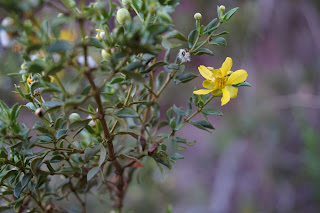
When I finally understood, I felt like a bit of a muppet (again.) (Also did that just now as I realised it's also the same thing as greasewood. Gah there is so much to learn!)
And weirdly, two of the signature plants of this kind of desert, sagebrush and creosote, both have species names 'tridentata'. Coincidence? Hmmmm.
Subscribe to:
Posts
(
Atom
)
